Good Dark Fantasy Books That Respect Their Women: 7 Picks
Here are seven good dark fantasy books that respect their women — and I want to be precise about what that means, because the bar is lower than it should be. It does not mean the women survive, or win, or get the romance arc. It means the text treats them as people with interiors the story is interested in whether or not they are being hurt. The hurt is not the point of them. That sounds obvious. A shocking amount of dark fantasy fails it, and the failure usually hides behind the word "gritty": a woman exists to die so a man can feel something, and the camera lingers. The seven books below do the opposite in seven different ways, and each one makes the genre darker, not softer, for doing it.
I have a stake in this question. My debut, The Seventh Vessel, is about a girl consecrated to a ritual use before she is old enough to understand what was taken, and the antagonist I built — Lady Kadin — never raises a hand to anyone. Her violence is arrangement: a seating chart, a compliment, a silence deployed at the correct moment. I wanted to prove to myself that dread does not require a violated body on stage. So the picks below are the books I studied while asking the same question, and each one answered it with a different tool.
A quick map before the long versions — what each pick costs, and who it is for.
| Book | Sub-genre | Dark element / cost | Best for |
|---|---|---|---|
| The Silence of the Girls | Mythic retelling | Captivity, erasure from song | Readers who want the count retold |
| A Game of Thrones | Political dark fantasy | War, marriage as battlefield | Readers who want women scheming |
| A Crown for Cold Silver | Grimdark epic | Revenge, a decade in disguise | Readers who want age honored |
| Fourth Wing | Dark romantasy | War college, a fragile body | Readers who want pain believed |
| A Deadly Education | Dark academia | A school that eats students | Readers who want rage kept |
| Empire of Sand | Atmospheric fantasy | Debt, coerced ritual duty | Readers who want consent on-page |
| Godblind | Grimdark war | Holy war, survival as labor | Readers who want cost accounted |
1. The Silence of the Girls — Pat Barker
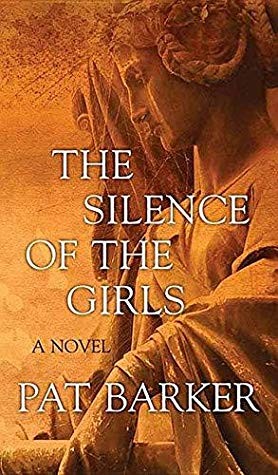
The Iliad, told from the slave quarters. Briseis, queen of a sacked city, is handed to Achilles as a war prize, and the famous quarrel with Agamemnon — the engine of Homer's whole poem — runs past her as property dispute.
What Barker does is a narration heist. In the source material Briseis appears and is removed, wordless, a line item in a king's grievance. Barker hands her the first person and keeps it, so the war arrives through women counting what it costs in blankets, in children, in the order you are raped in. The respect move is structural, not sentimental: the women do not become warriors, and their power is not retro-fitted. They get the microphone, and the poem has to survive being overheard. The pitch line people quote is Briseis's own: we will survive through our songs, and they will not be able to forget us.
The honest concession: the middle third drifts into campaign logistics and the prose stays deliberately plain — readers arriving from Madeline Miller's warmth will find it clinical. For readers who want the cost of war counted in domestic terms, Pat Barker's Women of Troy opener is the entry point. It pairs with the mythic picks in my underrated list if you want more women-first retellings in the same register.
2. A Game of Thrones — George R.R. Martin

You know the plot. What gets forgotten, in the decade of discourse since, is how the books treat the women relative to the show: as players the narration is invested in, not bodies the camera visits.
The craft bet I want to point at sits in the fourth volume, A Feast for Crows, when Martin finally opens a Cersei chapter. Three books of secondhand monstrosity collapse into recognition — you watch her reasoning, her terror of being underestimated, her slow mistakes — and the hatred mutates into something more uncomfortable: understanding without absolution. That is the respect: being granted interiority that does not flatter you. Meanwhile Catelyn carries the reader's judgment while the kings lie, Arya's survival is rendered as craft rather than pluck, and Sansa's careful social intelligence is treated by the prose as the weapon it is, long before the fandom agreed. The contested parts stay contested, and I will not relitigate the sexual-violence question here — only note that in the books, unlike a great deal of the imitator shelf, the women's chapters are where the trust lives.
Concession: it is a commitment — five doorstops and counting, with the famous pause. For readers who want dark politics where the women are the most competent people in the room and the narration knows it, start with the first volume and see how much of the modern grimdark shelf is arguing with this book.
3. A Crown for Cold Silver — Alex Marshall
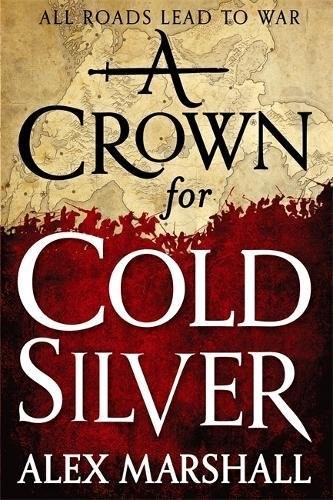
Five soldiers ride out of retirement to bury a friend, and their general is a fifty-year-old grandmother who has spent a decade living as a man. The novel's revenge scaffold — a betrayed rebel leader returned for the king who broke her — is familiar. The protagonist is not.
Here is the craft observation that earns the book its slot: the disguise is not a gimmick, it is the thesis. Zir's cross-dressing decade is treated as tactical infrastructure — safety, mobility, the accumulation of a second identity with its own debts — and the prose keeps both her age and her gender presentation in play as assets rather than quirks to be forgiven. Grimdark's roster of fifty-year-old male monsters is long; a woman of the same vintage, with grandchildren and a ruined body and a better claim to the throne than anyone on it, corrected a blind spot I had stopped noticing I had. The violence that is done to her over the series is real, but the narrative never reduces her to it — she is the subject of every sentence she occupies.
Concession: it runs long, the food digressions are a lot, and the comedic secondary voices divide readers cleanly in half. For readers who have decided grimdark has no use for an older woman at the center, this is the counterargument, and it is a violent one. It sits well next to the canon list if you are building a shelf.
4. Fourth Wing — Rebecca Yarros
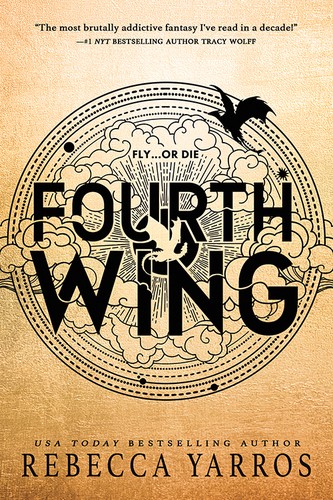
Violet Sorrengail is ordered into a war college designed to kill its students, riding dragons, on bones that fracture from a hard look. Her mother, the general who runs the place, sends her anyway. The book is the biggest commercial dark fantasy of the decade for reasons that are not this essay's topic — the reason it is on this list is quieter.
The respect move: the text believes her body. Violet's condition — chronic pain, joints that dislocate, coded readable as Ehlers-Danlos — is not cured by magic, not revealed as a trick, not overcome by montage. The world adapts. Saddle modifications, redistributed weight, training rebuilt around what her skeleton can carry, allies who adjust without making her gratitude the price. Yarros writes Violet's pain from lived experience, and it shows in the specifics: the calculations before a staircase, the shame that arrives before the injury does. Most fantasy heroines have bodies as plot devices. This one has a body as a fact the story budgets for.
Concession: the prose is functional rather than beautiful, and the late-book escalations strain the medical realism the early chapters earned. For readers who want the romance and the dragons without the heroine's body being erased by chapter three, this is the one — and if you have already read it, the self-published follow-list extends the lane.
5. A Deadly Education — Naomi Novik
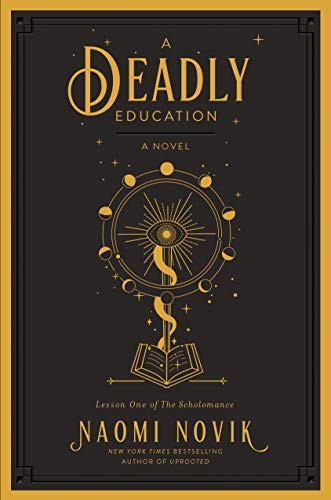
The Scholomance has no teachers, no exits, and a graduation rate best measured in survivors. Galadriel — El — Higgins was born with an affinity for apocalypse, and the school keeps trying to help her express it.
Novik's refusal is what I want to highlight: the book will not punish El into softness. The default arc for a girl with scary power is containment — she learns to be nice, the power is re-labeled as misunderstood, the story forgives her for existing. El's arc is the opposite of that. Her power stays wrong. Her anger stays intact. What changes is her aim — the same affinities pointed at protection instead of ending, which is a moral decision, not a personality transplant. The voice does the heavy lifting: a running, funny, furious monologue that carries dread in its complaints, so the dark never needs underlining. Female rage, kept and aimed, is the whole engine.
Concession: the worldbuilding arrives in mid-chapter essays and the pacing lurches badly in the first hundred pages; Orion, the golden rescuer boy, is deliberately thin. For readers who want a heroine the story never asks to apologize — Naomi Novik's Scholomance is the standard bearer.
6. Empire of Sand — Tasha Suri
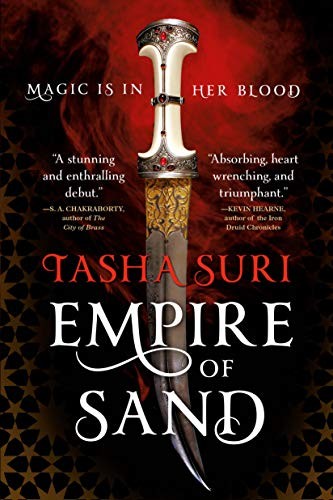
Mehr is the discarded daughter of a noble house, her mother's blood tying her to the desert spirits her father's empire fears. When the mystics who serve the Empire notice her, her stepmother sells her obligations, and the price is a marriage of duty to a man who must make her dance the rituals that hold the desert back.
The respect move is that the book treats coerced magic as horror. The ritual duty demands Mehr's participation — her dancing, her body, her consent — and Suri frames that demand precisely: the slow stripping of choice under family debt and imperial religion, with no dress on it. Because the book names coercion as the threat, the counterweight lands: every step of the central relationship is negotiated, asked, waited for. Consent on the page as mechanics, not as mood. The romance is slow enough that each granted inch carries weight, and the atmospheric prose — heat, salt, the pressure of a court that watches a mixed-blood girl for signs — makes the dread ambient rather than grafted on.
Concession: the first half is glacial, and readers wanting plot velocity will stall; the prose has a young-adult softness at the edges. For readers who want the "no" written down — and its Mughal-inspired world is a setting the genre has nowhere else — the patience pays.
7. Godblind — Anna Stephens
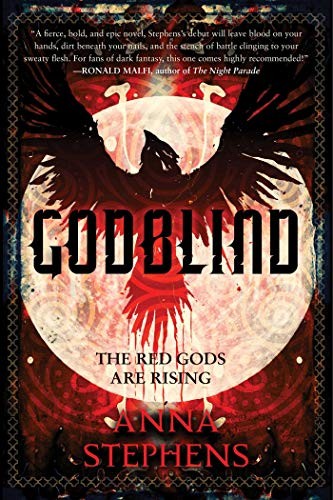
A holy war consumes the world: a prophet who hears the One True God, kings who mistake ambition for faith, and a land where the gods have gone silent. Among the swept-up is Rillirin — a former slave, a rape survivor, arriving in the first chapters as the most frightened person in the book.
Stephens writes grimdark as brutal as the male shelf's, and the difference is bookkeeping: what violence costs is accounted, and the women get arcs rather than funerals. Rillirin's is the visible one — fear into function into voice, across the trilogy, no montage, no rescue that fixes her — and the novel structures its moral ledger through its female POVs while the men burn things. Hers is not the largest role in book one; it is the one the series keeps its promises to. Grimdark that holds its own brutality to account, by making survival itself the labor the text respects. The book has faded from the conversation since 2017, which is exactly why it is here — this is the backlist pick nobody sold you.
Concession: it is bleak without relief, the POV roster is huge, and named characters die at a rate that exhausts. For readers who want war fantasy where the accounting is honest and the survivor is the arc, start here in the forgotten lane.
Where The Seventh Vessel fits
The thread through all seven: none of these books respect their women by protecting them. They do it by granting interiors, believing bodies, keeping rage, writing down the no, and letting survival be the story. That is the shelf The Seventh Vessel lives on. Nara is eight when she is consecrated as a vessel, and the horror of the book is never what is done to her body on the page — it is what was arranged for her, by family, by ritual, by a woman whose cruelty never requires raised hands. Lady Kadin is my argument that the scariest antagonist in dark fantasy can be a hostess. If the seven books above are your register, mine was written in conversation with them.
A reading order for these good dark fantasy books
Start with The Silence of the Girls — it is the thesis, and the shortest read that makes the case. Then Fourth Wing for the commercial counterweight, then Empire of Sand when you have patience for atmosphere, then A Crown for Cold Silver as the commitment, saving Godblind for last so its trilogy arc lands with the full weight. Take one craft question with you when you go: in the last dark fantasy you read, find the moment the story was interested in a woman when nothing was being done to her. If you cannot find it, the books above will recalibrate you. If this list earned its keep, the journal has more — and the newsletter at the bottom of this page is where new posts land first.
Keep reading below the dome.
Join the list for new lore and letters from City of One Tongue.
Dark fantasy at the edge of myth and resistance
By joining, you agree to the privacy policy. Unsubscribe anytime.