5 Books Like Fourth Wing That Actually Deliver on the Hype
You have read a books like Fourth Wing list before. You have read six of them. They all name the same six titles, in a different order, and by the third entry you can feel the list-maker slowing down, padding, reaching. The problem isn't the titles. The problem is the promise. Fourth Wing makes a specific offer — magic that charges you, a school where the casualty list is real, an ending with teeth — and most readalike lists answer it with books that share the packaging while dodging the promise.
So this list is organized around delivery. Five books. Each one keeps exactly one of the promises Fourth Wing makes on its cover, and keeps it past the ending, which is where most fantasy flinches. A couple are famous. One is a debut almost nobody bought. One is grim enough that I read it in daylight. I write vessel-and-rider dark fantasy myself, which means I am professionally suspicious of books that advertise cost and deliver a discount — these five passed the audit.
A quick map before the long versions — what each pick costs, and who it is for.
| Book | Sub-genre | Dark element / cost | Best for |
|---|---|---|---|
| Jade City | Clan-war fantasy | Deaths that stay dead | Readers who want stakes that stick |
| Ninth House | Occult dark academia | Institutional cover-ups, ghosts | Readers who want danger that is real |
| Prince of Thorns | Grimdark | No redemption, no softening | Readers who want dark all the way |
| Beyond Redemption | Grimdark hidden gem | Sanity spent as fuel | Readers who want magic that bills you |
| Master Assassins | Desert grimdark | A finished story, no hostage ending | Readers who want endings that close |
Why Most Books Like Fourth Wing Lists Disappoint
Because they match nouns instead of promises. Dragon-rider college, check. Enemies-to-lovers, check. But the reason Fourth Wing hit was never the nouns — it was that Rebecca Yarros let the war college actually graduate people into the ground. The delivery test this list runs has three parts, and every pick below passes at least one at full strength:
The magic has to charge something, and the bill has to arrive on the page — not in backstory, not in a prophecy, in scenes. The stakes have to land on named characters and stay landed; a casualty list that resets is a prop list. And the ending has to hold the book's tone instead of flushing it for the sequel hook.
Five promises. Five books that pay. Here is the receipt for each.
1. Jade City — Fonda Lee
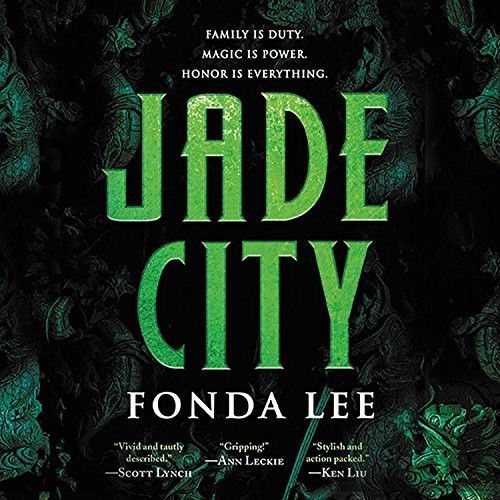
The promise Fourth Wing leans on hardest is a casualty list that sticks. No book on the shelf keeps it like Jade City — this is the one I hand people who say nobody dies in fantasy anymore.
On the island of Kekon, certain stones carry magic, and warriors who wear the jade — the Green Bones — channel it into speed and cutting edges and the authority to rule. The Kaul family runs the Noo clan on the strength of it: Lan, the young Pillar holding a dynasty together after his father's era ends; Hilo, the Horn, whose temper and knives are the family's street power; Shae, back from abroad and wanting out; and Anden, the youngest, at the academy, being shaped into a weapon. Act one is a clan dispute over territory and respect — a mafia story with martial-arts magic — and it escalates by the logic of feuds, which is to say predictably and then all at once.
The craft observation: escalation without a reset button. Lee plots like an organized-crime saga — every act of violence has an organizational consequence, someone's position, someone's succession — and when the first book closes on its loss, the next book builds on the grave instead of filling it in. I wrote about the jade-trade economics in an earlier list; the stakes-honesty is the deeper reason this series endures.
Honest concession: the first third is boardroom-slow — meetings, family hierarchy, Kekonese honorifics — and readers who want the knives immediately will wait for them.
For readers who want deaths that stay dead, and a series that never undeletes one.
2. Ninth House — Leigh Bardugo
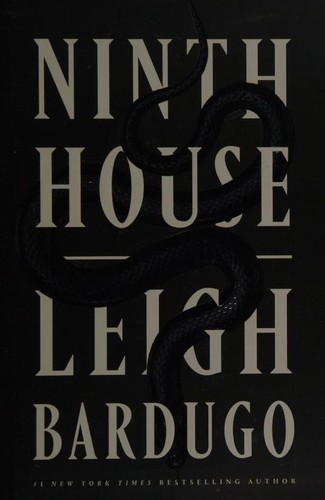
The second promise: a school that actually gets people killed. Most dark academia decorates the threat. Ninth House files the paperwork and bills the families.
Galaxy Stern — Alex — is in a hospital bed after a homicide when Yale makes her the strangest offer in the genre: a full ride, in exchange for monitoring the university's secret societies, whose rituals do real occult work beneath the alumni networking. Alex can see the dead — the Grays — and that makes her the one applicant alive who can do the job. She is installed in Lethe House, the order that oversees the other eight, and set to walking campus at night with a drug regimen and a supervisor. Then a murder lands that the university wants classified as nothing, and Alex, who knows what nothing looks like from the inside, refuses to file it.
The craft observation: Bardugo grounds the occult in institutional behavior. The horror here is administrative — funding, reputation, alumni complicity, the smooth institutional voice that turns a dead student into a liability. The ghosts are the second-scariest thing on the page. That grounding is why the danger reads as real: when it lands, the victim stays dead and the institution circles the wagons. I named it an anchor of the current dark-fantasy backlist for exactly this durability.
Honest concession: the cast is dense — eight houses of privileged names to track — and the middle third shuffles mystery paperwork while the atmosphere coasts.
For readers who want the school to be as dangerous as the brochure claims — the hardcover is on Amazon, and it rereads.
3. Prince of Thorns — Mark Lawrence
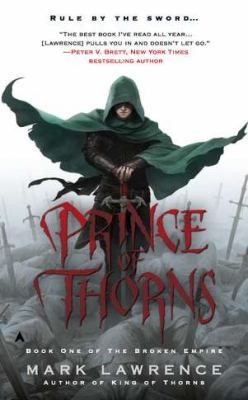
The third promise: dark on page one and still dark on the last page of the trilogy. If you have been burned by series that open brutal and spend three books apologizing for it, this is your book.
Jorg Ancrath is fourteen and running with a band of road-rats through a broken empire, and he is not a poor lost boy — he is a prince who walked away from his father's castle after renegades left him with something he cannot put down, and he has decided that grief is a resource like any other. He collects the band's loyalty the way he collects everything, takes what he wants, and starts the long march back toward a throne he intends to take rather than inherit. The empire around him is post-something — the ruins run deeper than any medieval Europe has a right to — and the book lets you feel that wrongness before it explains a syllable of it.
The craft observation: consistency as a structural choice. Lawrence does not sand Jorg into a hero across three books — there is no rehabilitation arc quietly refunding the darkness you bought in chapter one. What the blurb threatens is what the trilogy pays, to the last page. I recommended it before as a short, punchy entry point; the no-softening is the reason it holds up.
Honest concession: the violence in the opening chapters — including sexual violence — is a wall, and it is meant to be. Some readers should take that wall seriously, and the book does not negotiate.
For readers who were promised dark and want it delivered whole, without a redemption receipt.
4. Beyond Redemption — Michael R. Fletcher
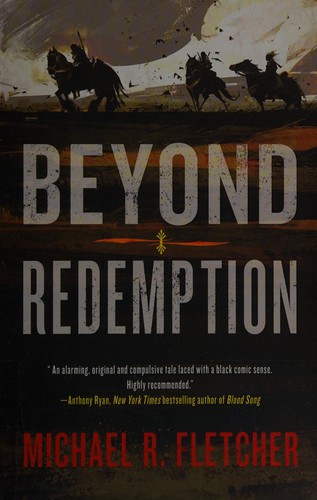
The fourth promise: magic with a price. Every system claims one; almost none invoice it. This book — the hidden gem of this list, a debut that never got its audience — builds the entire engine out of the bill.
The setting runs on the Geisteskranken: the mad, whose delusions impose on reality. Believe you are fire, hard enough, deep enough, and you are. The cost is built in at the root — the power spends the sanity that fuels it, so every feat tightens the spiral that made it possible. High Priest Konig of the Geborene church intends to grow a god: Morgen, a boy raised from birth to ascend and to obey. And a cabal of lunatics — Stehlen, a kleptomaniac; Wichtig, a swordsman who believes himself the greatest alive, which in this world is nearly a pension plan — sets out to kidnap the boy who would be god. Konig, meanwhile, is cracking, and a cracking mind here is a load-bearing event.
The craft observation: Fletcher refuses free power. Not one character in this book gets strength without the meter running — the delusion that grants the gift is the delusion that eats the giver — and the plot is what accumulates on the account. That is the entire promise of cost-based magic, honored at a depth the bigger names don't attempt.
Honest concession: the German-named cast and the delusion-logic make the middle stretch genuinely hard to track, and the tone is grimmer than entertainment — I read it in daylight, on purpose.
For readers who want magic that bills you, and a hidden gem to own before the internet finishes finding it — its Goodreads page is the cheapest audit of the claim.
5. Master Assassins — Robert V.S. Redick
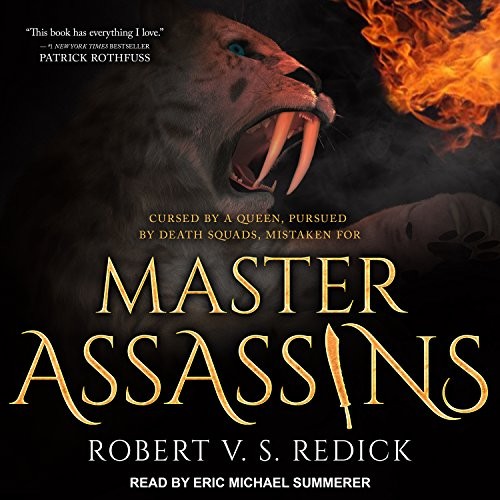
The fifth promise: an ending that closes. In a genre that ends volume one by pointing a gun at you until you buy volume two, this is the rare book that ends like a novel.
Kandri and Mektu Hinjuman are half-brothers drafted into the Army of Revelation, a faith-fueled war machine marching across a scorched continent under a Prophet nobody sane would cross. Kandri was never meant to be a soldier. Mektu — a gifted, incorrigible liar — was never meant for the world. A catastrophe they half-caused and half-stumbled into gets pinned on them, and by dawn they are the most wanted men in the desert, famous as master assassins, which is a profession they have never practiced and cannot refuse. The chase that follows is the book: the brothers, the pursuit, and a continent full of cults and opportunists converging on two nobodies with the worst reputation available.
The craft observation: closure as a deliberate craft position. Redick resolves the chase that drives the volume — the arc you were promised arrives and completes — while the wider world stays honestly open. A story can continue without holding your ending hostage; this book is the proof, and it is rarer than it should be. And Mektu, the lying brother, gives it a comic engine almost nobody else in grimdark is running.
Honest concession: Mektu is designed to annoy, and he does, sometimes past the point of charm; and the supporting cast of pursuers blurs together on the road.
For readers who want an ending that shuts the door it opened — the Goodreads listing still reads like a secret.
The reading order, and the takeaway
Start with Jade City — it is the on-ramp, propulsive and cleanly plotted, and it recalibrates what you accept from then on. Ninth House second: the grounding is modern, the dread is institutional, and it reads fastest after the clan machinery of Kekon. Prince of Thorns third, on a night you mean it — shortest book here, hardest commit. Beyond Redemption fourth, at the deep end, with the daylight rule. Master Assassins last, so the list closes on a book that closes. If what you actually want is the war-college side without the romance, that list is here; the full run of recommendations lives in the journal.
And since I audit books for promise-keeping for a living: The Seventh Vessel is mine, and it is built on the same contract — a girl consecrated to a use before she can consent to it, a bond between vessel and rider where the cost is printed on the page, and an ending that does not blink at what the magic charged. The promise on the cover is the promise in the book. That is the whole standard. These five are where I learned it.
Keep reading below the dome.
Join the list for new lore and letters from City of One Tongue.
Dark fantasy at the edge of myth and resistance
By joining, you agree to the privacy policy. Unsubscribe anytime.