6 Books Like Fourth Wing But Darker (Grimdark-Romantasy)
You finished Fourth Wing. The romance landed. The dragons landed. Somewhere around the third death you started to notice something missing — not a flaw, an appetite the book didn't feed. You wanted the darkness to cost more. You came back to search "books like Fourth Wing but darker," and the listicles kept pointing you at more dragon academies.
These six books take the parts of Fourth Wing that bite and let them draw blood. Two keep the romantasy frame and sharpen the blade. Two are full grimdark with no romance exit. One threads a monster through the protagonist's skull. The last is a standalone about what war-magic does to the body that survives it. All six are books I reached for after closing Fourth Wing and stayed up too late finishing.
A note on what "darker" means here, because the word has been worn smooth. I don't mean a higher body count — bodies are cheap in fantasy. I mean a price the story makes the protagonist pay in flesh, sanity, or someone they love, and refuses to refund. Fourth Wing's leg and its deaths gesture at this. These six commit to it. If that's the itch, this is the shelf.
1. The Poppy War — R.F. Kuang
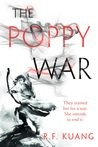
Start here if you want the romantasy-to-grimdark bridge, crossed at a dead sprint.
Rin is a war orphan from the southern provinces who aces the empire-wide exam and gets placed at an elite military academy. The first third looks like a school story with cruelty in the seams. Then she learns she's a shaman — a channel for the phoenix, one of the old pantheon — and the book stops being a school story entirely. The second half is the Second Sino-Japanese War wearing a fantasy skin, and it does not look away.
What makes this darker than Fourth Wing: the power isn't a bond, it's an inhabitation. Shamans channel gods, and the gods want to stay. The more Rin opens the channel, the less of Rin is left. Kuang treats magic the way the manuscript I'm writing treats memory — as a thing the body carries until the body can't. The cost is madness, then atrocity, then the question of whether the person who comes back is the person who left.
The honest concession: the first hundred pages read like a debut. The prose firms up once the war begins, but the academy setup leans on trope. Push through. The book Kuang is writing is the one that arrives in part two.
One specific scene, since vague praise is the AI smell I'm trying to avoid. Late in the book, after a city falls, Rin sits with a surviving officer and they talk about what comes next — and the officer explains, in plain words, that there is no next, that what happened will outlast everyone who saw it, and that the job now is to keep being useful anyway. That scene isn't in the synopsis. It's the one I remember. The romance beats in Fourth Wing land because Yarros keeps them grounded in what the war costs the couple. Kuang removes the couple and keeps the cost, and the cost is the whole book.
For readers who finished Fourth Wing and wanted the war to mean something the protagonist couldn't walk back from.
2. The Blade Itself — Joe Abercrombie
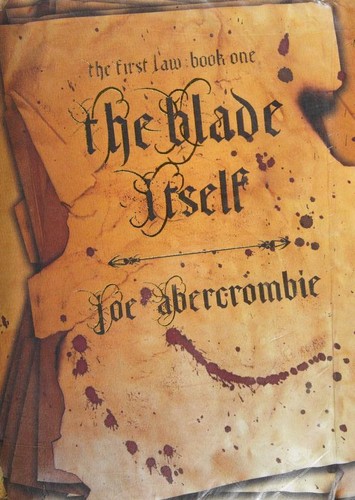
The grimdark floor. If Fourth Wing is the ceiling of what you've read, this is the basement — and I mean that as praise.
Three point-of-view characters carry the first volume of the First Law trilogy. Logen Ninefingers is a barbarian trying to stop being the worst version of himself. Inquisitor Glokta is a war hero turned torturer whose every paragraph is narrated through ruined nerves and missing teeth. Bayaz is a wizard old enough to remember when the world broke, and he's lying about most of it. None of them are heroes. All of them are written from the inside out.
The craft observation that matters: Abercrombie's voice. Each POV sounds like a different person, and the different person is the point — Fourth Wing is narrated in Violet's voice throughout. Abercrombie gives you three voices that disagree about what's happening and lets you triangulate. Magic in this book is mostly off-page, talked about in the past tense by people afraid of it, and that dread is the whole effect. The darker thing isn't what's shown. It's what the characters flinch from naming.
Honest concession: almost nothing resolves in book one. The First Law is a trilogy that reads as one long novel cut into thirds. If you want closure, you're signing up for three books. The ending earns the wait, but the wait is real.
For readers who wanted Fourth Wing's morally-grey instructors to get a POV chapter.
3. One Dark Window — Rachel Gillig
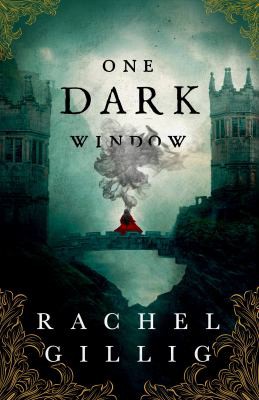
The romantasy pick that keeps the romance and adds a monster in the protagonist's head.
Elspeth Spindle lives in a cursed kingdom where magic is real but illegal — it leaks from a forest called the woods, and the woods drive people mad. To survive her family's ruin, Elspeth consumes a magic stone and gains a second consciousness: the Nightmare, a voice and a violence that lives behind her eyes. She needs a cure before the Nightmare takes her over entirely. The romance is with a highwayman who turns out to be tied to the court she's running from, and it threads through the plot rather than sitting on top of it.
The craft beat worth flagging: Gillig built the romance around the protagonist's unreliability. Elspeth can't fully trust her own thoughts because the Nightmare can surface them, and the love interest can't fully trust her for the same reason. The tension isn't manufactured by a misunderstanding — it's structural. That's harder to do than Fourth Wing's secrets-between-lovers, and it pays off in a different register.
Honest concession: the worldbuilding is thinner than the big romantasy pillars. Blunder (the kingdom) is more atmosphere than geography. If you read for maps and houses and heraldry, this will feel like a mood board that forgot the encyclopedia. The mood is the point.
A specific beat, because the structure is the thing. There's a moment where Elspeth tries to describe what the Nightmare knows about her own feelings, and she can't finish the sentence — not because she's hiding it from the love interest, but because the Nightmare can surface the truth before she's ready to say it. The love interest reads the silence as evasion. It isn't. It's a woman whose interiority has a witness she didn't consent to. Fourth Wing's secrets are plot beats; Elspeth's silence here is a character beat, and the romance can't move until the Nightmare moves first.
For readers who wanted Fourth Wing's romance to have a third party in the room — and for that third party to be a threat to both lovers.
4. Gideon the Ninth — Tamsyn Muir
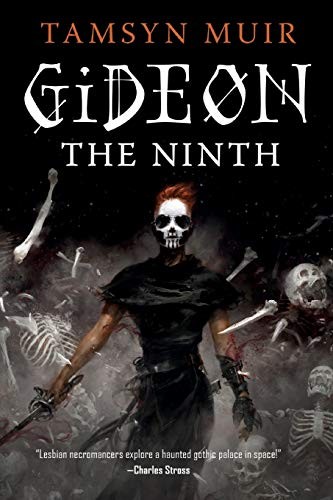
The wild card. Necromancers in space, a locked-room murder mystery, lesbian enemies-to-lovers, and a voice so singular it has no second-place finisher.
Gideon Nav is a cavalier — the sword arm — sworn to serve the necromancer Harrowhark Nonagesimus, who she hates. They're summoned to the Emperor's haunted house on a dead planet along with eight other necromancer-cavalier pairs to compete for an honor nobody will explain. People start dying. The structure is part Agatha Christie, part gothic horror, part meme.
What makes it darker than Fourth Wing: the necromancy costs bodies, and the book names whose. A necromancer's power rises on her cavalier's death — sometimes a little, sometimes all at once. The bond isn't romance-coded; it's a transaction written in bone. Gideon's voice is so loud and so funny that you don't notice, for about two hundred pages, that she is marching toward a bill she cannot pay. The ending collects.
Honest concession: the voice is polarizing. Gideon's internal monologue is sarcastic, profane, and reference-dense, and if you don't lock into it by chapter three, you won't lock in. The lore is also heavier than Fourth Wing — Muir does not hold your hand through the Ninth House politics. I needed the glossary twice.
For readers who wanted Fourth Wing's banter dialed up until the banter becomes a coping mechanism for grief.
5. The Serpent and the Wings of Night — Carissa Broadbent
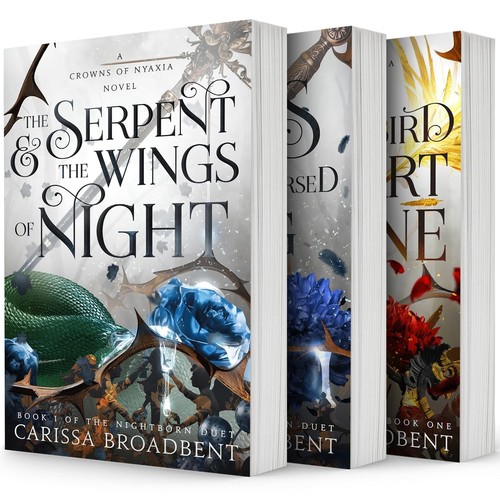
The romantasy frame Fourth Wing borrows from — but the blood is on the page.
Oraya is the human adopted daughter of the Nightborn vampire king, raised as a weapon in a city that considers her prey. Every hundred years, the Kejari — a deadly tournament run by a goddess — opens, and Oraya enters to win her freedom. To survive, she has to ally with Raihn, a vampire from a rival faction who should be her enemy. The tournament is kill-or-be-killed across escalating trials. The romance is enemies-to-lovers under a deadline.
What makes this darker than the academy frame: the trials kill named competitors, and Broadbent doesn't pad the deaths with redshirts. The first few rounds are a romance novel and a survival novel stacked on top of each other, and the survival novel is the one with teeth. The stakes are explicit — Oraya wins or she dies — and the romance has to make sense inside that, not around it.
Honest concession: the prose is workmanlike. Broadbent is a plot and tension engineer, not a sentence stylist. If you read for line-level craft the way I do, you'll notice the adverbs. If you read to find out what happens next, this is the fastest book on the list.
For readers who wanted Fourth Wing's tournament structure to actually cost the people in it.
6. The Sword of Kaigen — M.L. Wang
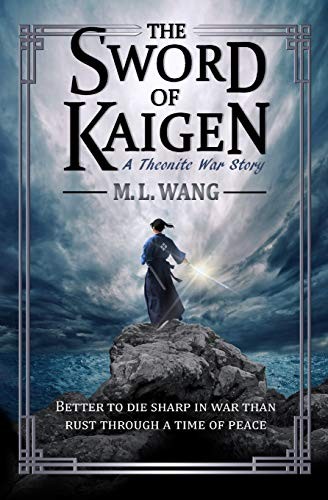
The hidden gem on this list, and the one that hits the "darker" brief hardest.
The Kaigenese empire sits on a cliff province defended by the Matsuda family — a lineage of breathing-sword fighters whose art turns breath into blade. Takeru Matsuda is the patriarch. Mamoru is his teenage son, trained since childhood to be the family's weapon. The first third is a domestic study of a mother and a son under the weight of a lineage that has used them both. Then an invasion arrives that the empire didn't warn them about, and the book becomes a war novel that refuses to look away from what a blade does to a body, on either end.
The craft observation I can't shake: Wang writes the war-magic as grief, not spectacle. The breathing-sword is the most cinematic thing in the book, and Wang stages the aftermath more carefully than the duel. There's a chapter late in the book — I won't spoil which — that is the most physically honest description of what a mother does after the worst thing that can happen that I've read in fantasy. It is not decoration. It is the book.
Honest concession: the worldbuilding name-generator sometimes clangs — the empire names lean generic. And the book is a standalone set in a larger world, which means some threads point at books that don't exist yet. Neither broke me. Both are real.
For readers who finished Fourth Wing and wanted the magic to land in a body that has to keep living in the house afterward.
What these six have in common — and why "darker" is the right word
A synthesis, since a list is only useful if you can see the pattern. These six books share one structural choice that Fourth Wing refuses to make: the cost is non-refundable. Rin cannot give the phoenix back. Logen cannot undo the men he killed. Elspeth cannot un-consume the stone. Gideon's cavalier bond is a debt that compounds. Oraya's tournament kills people she names. Mamoru's blade work leaves a house that has to keep being lived in.
That is what "books like Fourth Wing but darker" should point at. Not gore. Not grit for its own sake. A ledger the protagonist cannot close. Fourth Wing gestures at this with Violet's leg and a few funerals; these six commit to it as the engine of the plot. If you bounced off one of the books above, try another — they each take the brief in a different direction, and the gap between them is wide enough that one will land even if another doesn't.
Where to start, and what to read after
If you want the smallest step from Fourth Wing — start with The Serpent and the Wings of Night. The tournament frame will feel familiar, and the darkness tightens from there.
If you want the biggest step — start with The Blade Itself. Read the trilogy. By the end you'll know whether grimdark is a lane or a detour for you.
And if you want a romantasy frame where the bond is the cost, not the perk — The Seventh Vessel is mine. It's the book these six pointed me toward, written in the gap between them. You can read the opening on the homepage, browse the rest of the journal, or pick it up on Amazon.
The darker itch Fourth Wing leaves you with isn't a defect. It's a doorway. These six are on the other side of it.
Keep reading below the dome.
Join the list for new lore and letters from City of One Tongue.
Dark fantasy at the edge of myth and resistance
By joining, you agree to the privacy policy. Unsubscribe anytime.